99.9%
Moisture-Sensitive Precision Work
Purity ≥99.9 wt% · Water ≤0.02% · Residue ≤1 mg/100 ml
View Grade
Home/Ethyl Acetate Urethane Grade
Urethane Grade
Ethyl acetate specified for polyurethane systems, where water and ethanol are the two impurities that consume isocyanate and shorten pot life. The grade is bought for those two limits, not for a higher assay figure.
Data
Water and ethanol are held below the published Sasol limits, as an internal control for PU work.
| Property | Limit |
|---|---|
| Purity | ≥99.8 wt% (GC) |
| Water | ≤0.02 wt% |
| Ethanol | ≤0.02 wt% |
| Acidity as acetic acid | ≤0.005 wt% |
| Colour | ≤5 Pt-Co |
| Residue on evaporation | ≤2 mg/100 ml |
Typical values, not for specification. The published Sasol limits (water max 0.03%, ethanol max 0.02%) already cover most polyurethane systems; the values above describe the tighter internal control used for this grade.
NCO Balance
Water is not a solvent impurity in a PU system; it is a co-reactant. One molecule of water consumes two isocyanate groups before the polyol reaches them.
By mass, 18 g of water destroys 84 g of NCO, a ratio of 4.7 to 1. Read that against the solvent charge and the water limit stops looking small.
| System | Suggested solvent water max | Why |
|---|---|---|
| Prepolymer dilution | ≤0.02 wt% | Pot life is the first symptom; viscosity drift follows within the batch. |
| Two-component topcoat | ≤0.02 wt% | Measure before let-down, not after catalyst addition, when nothing can be corrected. |
Take the NCO content of the resin, apply the 4.7 to 1 mass ratio to the water in the solvent charge, and express the loss as a share of the NCO you paid for. That number, not the solvent specification alone, sets the limit worth buying.
Processing
Most failed moisture results in a PU plant come from equipment, not from the delivered drum.
Applications
Chosen for water and ethanol control, not for the purity number on the label.
Packing
Batch locking keeps the water figure consistent from drum to drum.
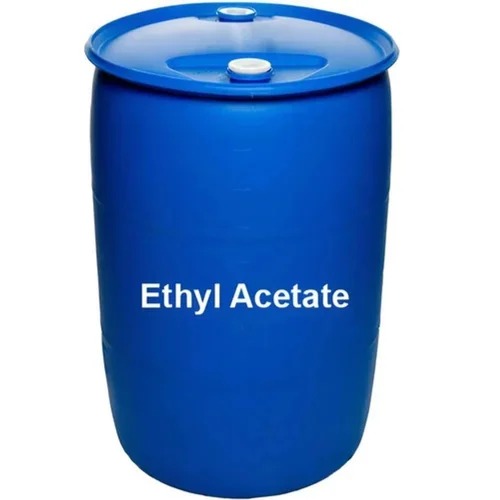
Approx. 180 kg net, closed-head steel drum.
Approx. 900 kg net, with a closed transfer connection.
Single-lot tank, with batch locking for continuous production.
Fill weights are calculated at a density of approx. 0.90 g/ml at 20 °C and confirmed per order. Dangerous goods declaration follows UN 1173, Class 3.
Grades
For the tightest trace control, or the standard grade behind most coatings work.
99.9%
Purity ≥99.9 wt% · Water ≤0.02% · Residue ≤1 mg/100 ml
View Grade99.8%
Purity ≥99.8 wt% · Water ≤0.03% · Ethanol ≤0.02%
View GradeNews
Technical, knowledge and commercial notes on the urethane grade.
Technical
Each trace of water in urethane-grade ethyl acetate consumes isocyanate. How to set limits and protect pot life.
Knowledge
What separates urethane grade from the standard grade, and which tests buyers should ask to see before ordering.
Commercial
Volume planning, packing choice and documentation for urethane-grade buyers in coatings and adhesives.
Contact
Send the grade, the volume and the destination port. A named contact replies within one working day.
Kristy Chen
 Scan to WhatsApp