NF/USP Grade
American Pharmacopoeial Route
Assay 99.0–100.5% · Water ≤0.2% · Residue ≤0.02%
View Grade

Home/Ethyl Acetate EP
EP Grade
Sasol lists Ethyl Acetate EP as a 99.80% mass purity product with availability in Europe. It is the pharmacopoeial route for European buyers and for export orders that arrive with an EP certificate requirement attached.
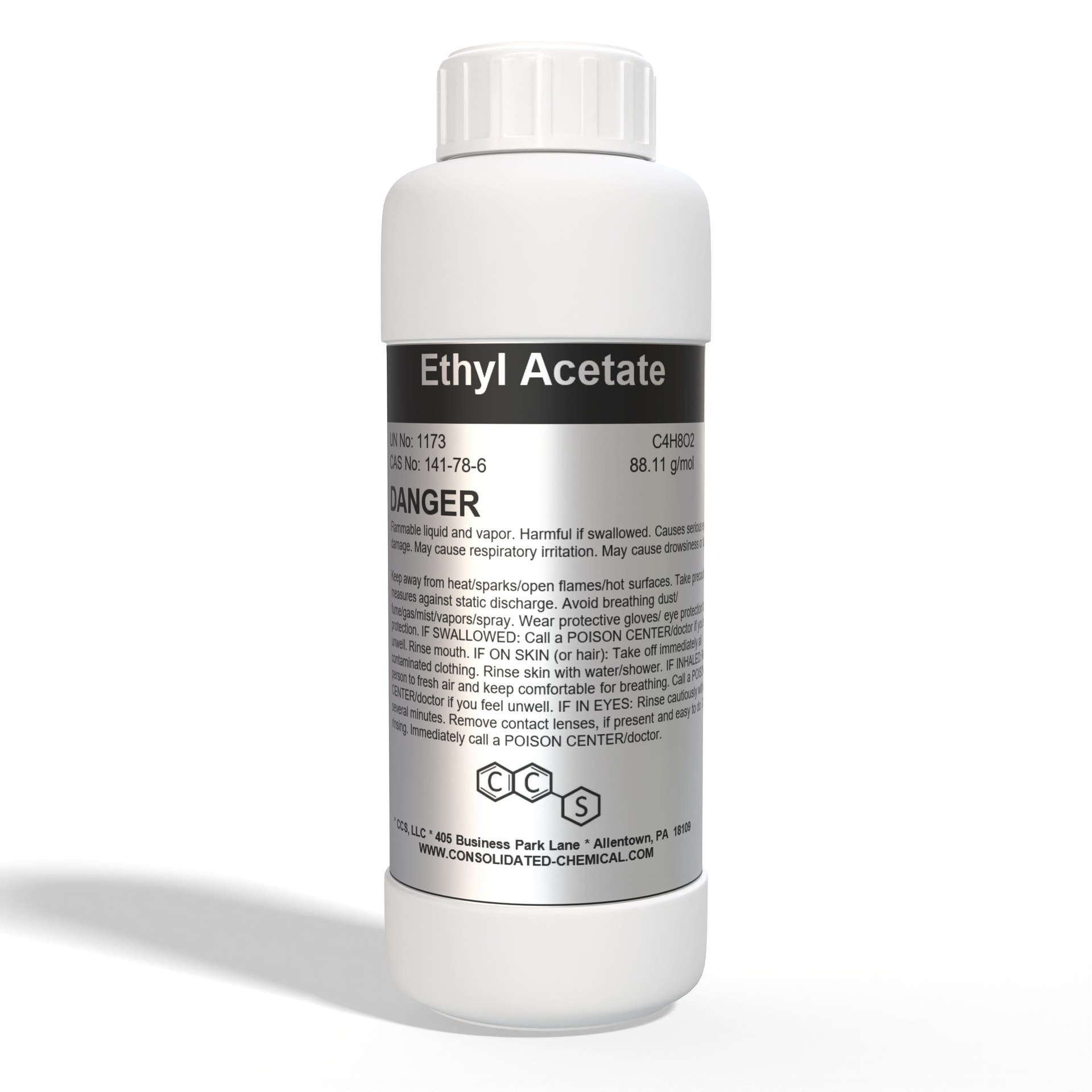
Data
Sasol publishes the product at 99.80% mass purity. The remaining limits come from the Ph. Eur. monograph and are verified against the current edition before a lot is released.
| Property | Limit |
|---|---|
| Purity (Sasol product data) | 99.80% mass |
| Relative density at 20 °C | 0.898–0.902 |
| Refractive index at 20 °C | 1.370–1.373 |
| Water | ≤0.1% |
| Residue on evaporation | ≤30 ppm |
| Related substances, total | ≤0.2% |
| Acidity | Passes test, EP method |
| Sulphuric acid colour test | Passes test |
Limits follow the Ph. Eur. monograph and must be verified against the current edition. Sasol lists the product at 99.80% mass purity. Where a customer specification is tighter than the monograph, the customer specification governs and is printed on the order.
Pharmacopoeia
Two pharmacopoeial routes lead to the same ester. What separates them sits in the test list, the bench time per lot and the language of the paperwork.
EP: European Pharmacopoeia
NF / USP: United States Pharmacopoeia
Handling
A pharmacopoeial lot fails on contamination long before it fails on age. Four habits keep the certificate valid in your plant.
Applications
European pharmacopoeial work, personal care formulas and flavour extraction, plus export orders that arrive with an EP document requirement.
Packing
Sealed packing is the default for a pharmacopoeial lot. Availability is confirmed against the region the goods are going to.
Closed-head drums with intact seals, the lot number on the label and the certificate matched to that lot.
Offered where the receiving site can keep the parcel sealed and the volume justifies the container.
Sasol lists EP grade availability in Europe; deliveries elsewhere are arranged from stock or by transfer, with the documentation route agreed per order.
Lead time outside Europe depends on stock position and transfer routing and is confirmed per order. Fill weights are calculated at a density of approx. 0.90 g/ml at 20 °C. Transport follows UN 1173, Class 3.
Grades
The American pharmacopoeial route, and the grade that carries a published Sasol specification.
NF/USP Grade
Assay 99.0–100.5% · Water ≤0.2% · Residue ≤0.02%
View Grade99.8%
Purity ≥99.8 wt% · Water ≤0.03% · Residue ≤2 mg/100 ml
View GradeNews
Technical, knowledge and commercial notes on the EP grade.

Technical
Relative density, refractive index, water, residue and related substances, read against the Ph. Eur. monograph.

Knowledge
How the two pharmacopoeial routes differ in tests, limits and paperwork, and how one lot can serve both.

Commercial
Regional availability, the cost of stock versus transfer, and the lead time documents add to an EP order.
Contact
Send the grade, the volume and the destination port. A named contact replies within one working day.
Kristy Chen
 Scan to WhatsApp