
Knowledge
Choosing NF or USP Grade Ethyl Acetate
How to read a pharmacopoeial certificate, what lot traceability covers, and where food use differs.


Technical
2026-10-13
The NF and USP monographs read like a bench card: assay 99.0–100.5%, chromatographic purity not less than 99.5%, and relative density 0.894–0.898 at 25 °C.
The remaining limits are water 0.2% max, residue on evaporation 0.02% max and titratable acid 0.0009 meq/g max. They are looser than a solvent specification because the monograph is written for pharmaceutical use.

Two items read as pass or fail: the methyl compounds test and the sulphur colour test. There is no number, only an outcome, and the outcome is what the certificate states.
Not every line on the certificate carries the same weight. Assay, density, chromatographic purity and residue decide release; the rest is trend data that shows drift before it becomes a claim.
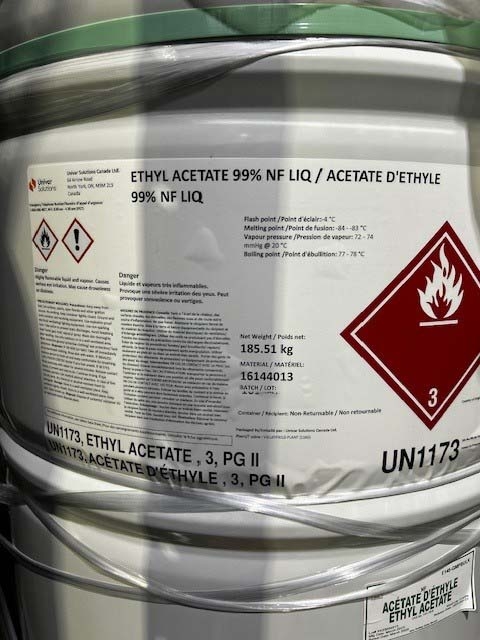
Related Product
NF and USP monograph limits for pharmaceutical and food-flavour use.
More Reading
Knowledge
How to read a pharmacopoeial certificate, what lot traceability covers, and where food use differs.
Commercial
Planning sealed-drum and ISO tank orders of pharmacopoeial ethyl acetate, with documentation and storage notes.
Contact
Send the grade, the volume and the destination port. A named contact replies within one working day.
Kristy Chen
 Scan to WhatsApp